

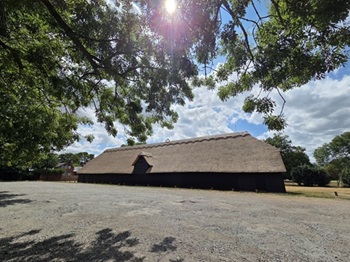
 Enjoying an open aspect onto Hall Lane this playing field supports rugby and football.
A pleasant area for walking, with a play site with outdoor gym, inclusive play equipment and multi-use games ball court for children to enjoy.
The area is also home to the Tithe Barn.
A 14 Hectare site primarily used for football and rugby but with open views out to the Laindon Hills.
The site is also home to the late-14th/15th-century Tithe Barn.
There is a play area, multi use ball courts and outdoor gym near the sports pavilion.
The major restoration project of the 15th-century Upminster Tithe Barn in Havering major restoration project was completed in 2025 and the building was officially removed from Historic England’s Heritage at Risk Register, making it fit for the future.
The funding for the repair of the barn saw the Council contributing £142,645 along with a grant of £650,000 from National Highways via the Lower Thames Crossing scheme and an additional grant of £97,664 awarded by Historic England.
The works included full re-thatching, plus structural timber and brickwork repairs to the building.
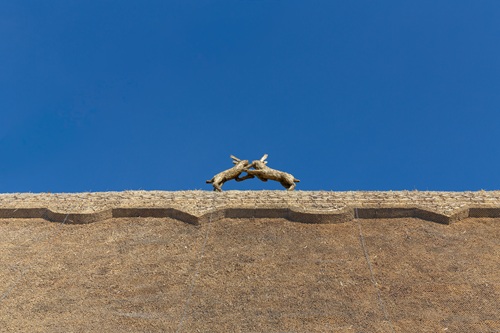
Along with the golden thatch of water reed, the barn is topped with a pair of straw hares. They have been named Willow and Hunter by children in Year 5 at nearby Branfil Primary School.
The building itself is one of the largest thatched barns in the country and has been dated to 1430-1450 and is a Scheduled Monument.
It is one of the earliest surviving buildings in the borough.
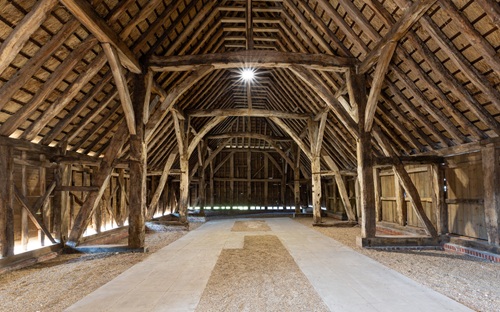
Interior picture of the barn provided by Liane Ryan.
Hall Lane, Upminster RM14 1AU.
Car Park off Hall Lane.
There are two bus routes that pass along Hall Lane and stop close to the playing fields.
The 248 runs between Romford and Cranham, and the 347 runs between Romford and South Ockenden.
There are no restrictions on pedestrian access however the car park is closed approximately at dusk and opened by 8am.
Upminster Hall Playing Field are on land that was formerly part of the estate of Upminster Hall, once the hunting seat of the Abbots of Waltham Abbey.
It was one of 17 manors given to the Abbots by King Harold. At the Dissolution of the Monasteries in the C16th Henry VIII granted Upminster Hall to Thomas Cromwell, following whose execution the estate passed through various illustrious owners, the last private resident being Major Godfrey Pike.
Chapman and Andre’s map of 1777 shows formal gardens to the east of the house and plantations in the north. Upminster Hall, a largely C15th/C16th timber-framed building, with later additions made over the years including a C17th north wing, is now the clubhouse of the Upminster Golf Club.
For many years the land that is now occupied by Upminster Hall Playing Field was leased for an agricultural depot, but when Upminster Estates were being development it was decided that recreational facilities should be provided.
As a result 6.5 acres were reinstated as grassland in 1957, with a further 6 acres added in 1958/9. An avenue of mature horse chestnut and walnut trees divides the two pieces of land and new trees have been planted.
The south side in particular has some fine old trees. In 1961 the then Superintendent of Parks and Cemeteries wrote that 'It is visualised that this area could ultimately form one of our most beautiful natural parks with an unbroken vista to Laindon Hills'.
Near the Playing Field and separated by woodland is a late C14th/C15th Tithe Barn.
N/a
Outdoor gym available on this site.
No public toilets.
Tithe Barn (opening hours vary).
Play equipment.